Hardware Is the New Moat
Inside Octoco's Hardware & Embedded Systems capability, and the problems we take on.
Building software has never been faster or cheaper. AI can turn a clear idea into working code in an afternoon, and that is good news. It gives more people the ability to build, experiment and bring products to market.
It also changes where competitive advantage comes from.
When capable software is increasingly accessible, a product needs something more difficult to replicate. For many technology businesses, that advantage sits in the physical product.
Hardware and embedded engineering still require years of experience, specialised equipment and extensive testing. A circuit designed for a product has to perform under the conditions it was built for, whether that means heat, vibration, long operating hours or years of use in the field.
Those constraints take time and engineering judgement to work through. They also create something valuable: knowledge and capability that are difficult for a competitor to reproduce quickly.
That is where hardware becomes a moat.
The tools got better, and that is good
Lower barriers to building technology benefit everyone, including engineering teams.
AI and better development tools are accelerating parts of hardware and embedded work too. Our engineers can use them to speed up tasks such as writing and adapting firmware, or moving working code from one processor to another.
The engineering work remains.
Tools can reduce repetitive tasks and speed up development, but they cannot make the judgement calls that come from experience. They cannot test whether a component will perform reliably in a specific environment or decide how a technical choice today could affect manufacturing later.
As more capabilities become widely accessible, the competitive advantage shifts towards the parts of product development that still depend heavily on expertise, experience and iteration.
Hardware is one of those areas.
What stays hard to copy
There are a few things that take much longer to build than a product feature.
Experience
Good hardware engineering involves thousands of decisions.
Which component will hold up at the required operating temperature? Where could the design fail after years of use? Will a decision that works perfectly on a prototype create problems when the product goes into manufacturing?
The answers come from technical knowledge, but also from experience.
Our team has been making those decisions since 2020, across many industries. Every project adds to the knowledge engineers bring into the next one.
The lab
Hardware needs to be tested physically.
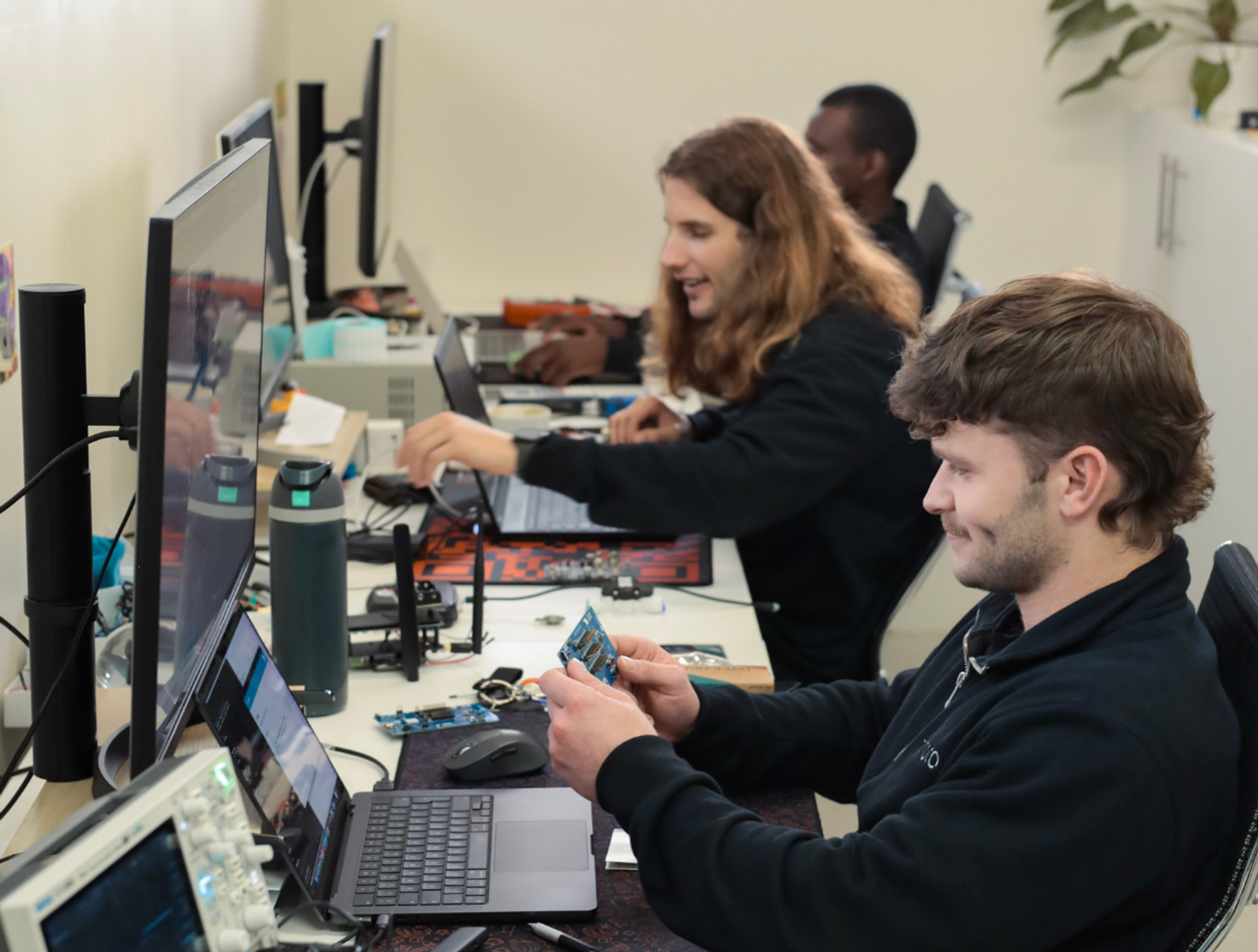
Octoco runs its own hardware and embedded lab in Stellenbosch. Having that capability in-house allows the team to test, investigate and iterate throughout development rather than treating testing as something that happens only at the end.
A simulation can be useful. So can modelling and analysis. Eventually, though, the product needs to be built, tested and pushed until weaknesses start to show.
Iteration
Software and hardware fail differently.
A software issue might show up in a log file. A hardware issue might involve overheating, unexpected current consumption, signal interference or a device that stops communicating once it has been deployed.
Finding and fixing those problems takes investigation and repeated testing.
Every serious hardware team has a collection of boards that did not make it into the final product. They represent the testing, learning and refinement behind the finished design.
Time, accumulated knowledge and the ability to test repeatedly create an advantage that is difficult to build overnight.
Why clients bring us their hardest problems
Much of the work that reaches our Hardware & Embedded Systems team starts with a problem that does not have an obvious off-the-shelf answer.
The challenge might be specific to a product, an operating environment or a particular set of technical and commercial constraints. Existing technologies might solve part of the problem without solving the whole thing.
That is where bespoke engineering becomes valuable.
We do not start by trying to fit a problem around a technology we already know well. We start by understanding the requirements, drawing on experience from previous projects and researching the areas where the answer is not immediately obvious.
Then we recommend the approach that best suits the product and its constraints.
Sometimes that means using familiar technology. Sometimes it means taking a more difficult technical path.
A bespoke solution takes more engineering effort than applying a standard template, particularly when the problem itself falls outside the boundaries those templates were designed for.
What that looks like in practice
One client came to us with a tracking device that was not reliable enough for the business to grow. It needed to do more, use less battery power and be affordable to produce in large numbers.
Rather than starting again, our team first worked out what was going wrong. We improved the software inside the device, changed how it connected to wireless networks and found ways to add new features without draining the battery or making the device less dependable.
This involved making a series of practical decisions. Every new feature had to be weighed against its effect on battery life, reliability, size and cost. The team built and tested several versions, learning from each one and improving the design as they went.
They also thought about how the device would be made in large numbers from the beginning. The product itself, the testing process and the systems used to prepare each device for use all needed to work together efficiently.
Over approximately a year, the product went through three iterations before reaching a design capable of supporting production volumes of up to 40 000 devices per month.
The finished product is only one part of the work. The real value lies in the process behind it: understanding the problem, questioning assumptions, testing different approaches and making sure the final design could work reliably in the real world and at scale.
A team that questions everything
One characteristic of our hardware team is their tendency to question assumptions.
That can mean checking whether the obvious solution is genuinely the best one, revisiting an early design decision or digging deeper when a fault does not behave the way it should.
It is an essential habit in hardware engineering.
Debugging can involve tracing signals with a probe in hand, investigating a component-level issue or tracking down a problem hidden in firmware timing. Engineers need to work systematically, test their assumptions and keep looking when the first explanation does not hold up.
Problem-solving sits at the centre of that process.
The team is also prepared to explore more difficult approaches when a simpler one will not meet the product requirements. Knowing when that risk is justified is part of the engineering judgement that comes with experience.
That willingness to investigate, challenge and experiment is often where the most interesting technical work begins.
One team, from concept to production
Many hardware problems emerge between stages of development.
A design can work well as a prototype but become difficult or expensive to manufacture at scale. A manufacturer may need to make changes without having the full context behind the original engineering decisions. Information can be lost when responsibility moves between separate teams.
At Octoco, we keep the product development process connected from concept through to production.
In practice, that includes:
- The schematic, mapping how the electronic components and systems fit together before anything physical is built
- PCB design and manufacture, turning that design into the physical board
- Testing and rework, identifying issues and refining the design through multiple iterations
- Integration, bringing the electronics together with the wider product and its enclosure
Manufacturing considerations form part of the engineering process throughout development.
The team carries context from one stage to the next, understands how earlier decisions affect later ones and remains involved as the product moves towards production.
That continuity helps avoid unnecessary handovers and allows the engineering team to take responsibility for the product as a whole.

How we build
Our approach is straightforward.
We aim to design technology that delivers maximum value while managing unnecessary risk. We stay transparent about technical trade-offs and remain involved throughout the development process.
That requires experience, the ability to test and iterate, and a team that understands the product from the earliest concept through to production.
Those capabilities take time to build.
Software development is becoming faster and more accessible, opening up new opportunities for companies building technology products. Hardware remains a specialised discipline where engineering experience, testing capability and accumulated knowledge continue to matter enormously.
For companies building physical products, that difficulty can become a competitive advantage.
The engineering knowledge behind a well-designed product, the testing that refined it and the experience required to take it into production are all difficult to replicate quickly.
That is the moat.
If you have a hardware or embedded product in development, or the beginnings of an idea, [talk to our Hardware & Embedded Systems team / book a session with our engineers].
We will help you understand what it will take to build it properly.